 EN910–12
Story preview
Race to the Moon
This book is the middle adventure in a three-book series called Star Roads. Book 1 followed early rockets and Yuri Gagarin, Book 2 races toward the Moon, and Book 3 will show how rivals slowly learned to work together among the stars.
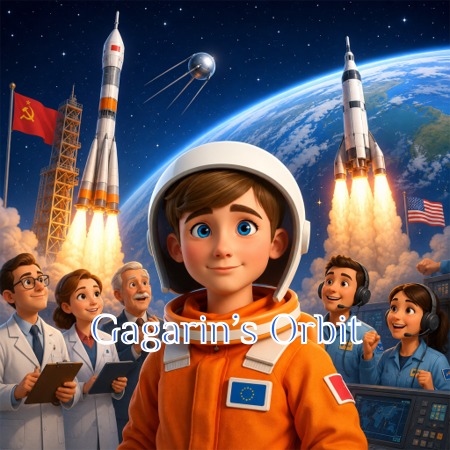
On 12 April 1961, Yuri Gagarin rode Vostok 1 around Earth and became the first human in space. His single orbit lasted only 108 minutes, but it changed history, because it proved that a person could survive launch, weightlessness, and return through the fiery air.
In the Soviet Union, Sergei Korolev led secret teams of engineers who turned mathematics, metal, and fuel into roaring spacecraft. In the United States, Wernher von Braun helped develop powerful rockets, including the mighty Saturn V, which would later stand taller than a 36-story building.
After Gagarin's flight, President John F. Kennedy felt enormous pressure, but he also saw a daring goal that could inspire science and teamwork. In 1961, he challenged the United States to land a person on the Moon and return him safely to Earth before the decade ended.
The Soviet Union continued to achieve dramatic firsts, showing that the race was still close and surprising. In 1963, Valentina Tereshkova flew aboard Vostok 6 and became the first woman in space, orbiting Earth 48 times and proving that exploration was not only for men.
In 1965, Alexei Leonov opened his spacecraft hatch and made the first spacewalk, floating outside in a stiff, ballooning suit while Earth rolled beneath him. A spacewalk, also called EVA, lets astronauts work outside, but Leonov's difficult return showed how dangerous even a few minutes in space could become.
On 16 July 1969, Apollo 11 launched from Florida on top of the Saturn V, powered by von Braun's rocket team and guided by many NASA groups. Neil Armstrong, Buzz Aldrin, and Michael Collins traveled for three days toward the Moon, each with a different but equally important job.
On 20 July 1969, Armstrong stepped onto the Moon, and Aldrin followed, collecting rocks, setting up experiments, and showing that careful preparation could turn an impossible dream into footprints.