 EN116–8
Story preview
Countdown to Space
Series Launch, 1903-1958. This is Book 1 of a three-book journey about how humanity reached space: first come the rocket dreamers and satellites, next comes Yuri Gagarin, and finally comes the race to the Moon. Our timeline begins before anyone had seen Earth from above, when space was still mostly a place for imagination, mathematics, and daring questions.
Early 1900s: Konstantin Tsiolkovsky, a Russian schoolteacher who was partly deaf, filled notebooks with calculations about rockets long before rockets could reach space. He explained that a rocket could move in empty space by throwing gas backward, just as a skateboard rolls forward when you push backward with your foot. He also imagined multi-stage rockets, which drop empty fuel tanks in sections so the remaining rocket becomes lighter and faster.
1926: Across the ocean, Robert Goddard tested one of the world’s first liquid-fuel rockets in a snowy field in Massachusetts. His strange machine rose only briefly, but it proved that burning liquid fuel could push a rocket upward with more power and control than earlier designs. Many people laughed at his ideas, yet his careful experiments helped turn rocket science from dream into engineering.
1944-1945: During World War II, Nazi Germany built the V-2 rocket, a weapon that could fly faster than sound and fall from the sky with terrifying speed. After the war ended in 1945, both the United States and the Soviet Union studied captured V-2 parts, documents, and experts because the same technology that carried explosives could also carry instruments, satellites, or someday people. This legacy was uncomfortable but important: science can be used to harm or to explore.
Late 1940s: The world changed into a tense period called the Cold War, not a direct battle between the USA and USSR, but a long rivalry of politics, ideas, weapons, and influence. Each side worried that the other might become too powerful, and each wanted to show that its system could build the future. Rockets became symbols of safety, science, and national pride all at once.
In the Soviet Union, Sergei Korolev became the hidden chief designer of a giant rocket program, though his name was kept secret for years. In the United States, Wernher von Braun, who had worked on the V-2 in Germany, became an important rocket engineer for American projects. Their teams included mathematicians, welders, radio experts, doctors, machinists, test pilots, and thousands of people whose names rarely appeared in newspapers.
1955-1957: Scientists around the world prepared for the International Geophysical Year, a peaceful research program to study Earth, oceans, weather, magnetism, and the upper atmosphere. Both the USA and USSR announced plans to launch artificial satellites, which are human-made objects that circle Earth. Satellites mattered because they could improve communication, help predict weather, make maps, study radiation, and show that a rocket could reach across the world.
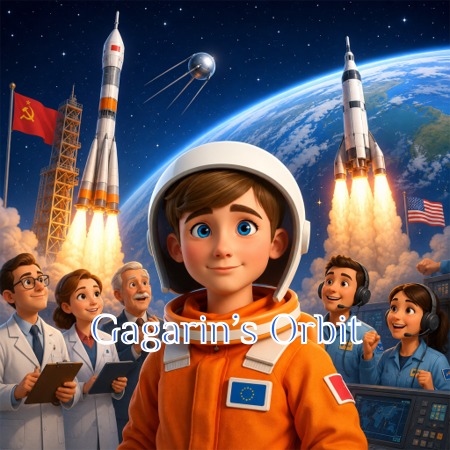
October 4, 1957: The Soviet Union launched Sputnik 1, a polished metal sphere with four long antennas, and its steady beep-beep crossed the sky by radio. It was small, but its meaning was huge: humans had placed the first satellite in orbit. Around the world, people looked upward with wonder, while leaders in Washington and Moscow understood that a scientific success had become a political message too.