 EN610–12
Story preview
Gagarin’s Orbit
This is Book 1 in a coordinated three-book journey about Yuri Gagarin, the first human in space, and the USA-USSR race that later reached the Moon. Our shared theme is simple but powerful: competition, courage, science, and teamwork carried humanity from early rockets to Earth orbit, and then toward footprints on lunar dust.
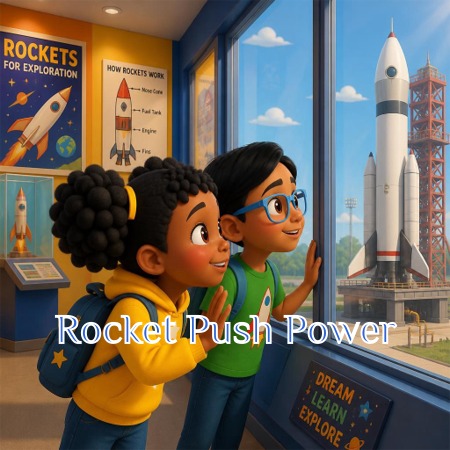
Long before anyone rode a rocket, Konstantin Tsiolkovsky imagined how machines could travel beyond the sky. He explained that rockets work by pushing gas backward, which pushes the rocket forward, and he helped people understand that space travel was not magic but a problem science might solve.
Yuri Gagarin was born in 1934 in the village of Klushino, in the Soviet Union, during a difficult time in world history. His family lived simply, and as a child he saw airplanes overhead and wondered how humans could build such powerful wings of metal. Yuri grew into a cheerful, hardworking student with a famous smile, but he was not a fairy-tale hero who felt no fear. He studied metalworking, joined an aviation club, learned to fly small planes, and discovered that bravery often means preparing carefully while your heart beats fast.
After training as a military pilot, Gagarin was chosen for a secret new program that needed men who could stay calm, follow instructions exactly, and fit inside a very small spacecraft. The Soviet Union called its space travelers cosmonauts, from words meaning universe sailors, while the United States called theirs astronauts, meaning star sailors.
Behind the Soviet program stood Sergei Korolev, the brilliant Chief Designer, whose name was kept secret for many years because rockets were important to national security. Korolev led huge teams of engineers, metalworkers, mathematicians, doctors, radio experts, and launch crews who turned drawings into roaring machines. The political pressure was intense because the Soviet Union and the United States were rivals during the Cold War, a time of competition without direct war between them. Soviet leader Nikita Khrushchev wanted space successes to prove his country’s strength, while American leaders watched closely and pushed their own scientists to answer.
On April 12, 1961, at Baikonur Cosmodrome, Gagarin climbed into Vostok 1 wearing a pressure suit and helmet. When the rocket engines thundered alive, he reportedly called out an excited word meaning Let’s go, and the stacked rocket lifted him away from Earth in a tower of flame. Launch meant the rocket had to push hard enough to escape Earth’s thick lower air and reach orbital speed, about 28,000 kilometers per hour.
During his single orbit, Gagarin saw oceans, clouds, land, and the curved edge of our planet through a small window. Weightlessness made objects seem to float because he and Vostok 1 were falling around Earth together, and for 108 minutes the world learned that a human could live and work in space. Reentry was another dangerous chapter because Vostok 1 had to slow down and plunge back through the atmosphere, where air rubbed against the capsule and heated its outside. The equipment section did not separate neatly at first, the spacecraft tumbled for a while, and Gagarin had to trust the design, his training, and the teams listening from below.
Near the end, Gagarin ejected from the capsule as planned and parachuted separately to the ground in the Saratov region, while Vostok 1 landed nearby. Farmers and a young girl saw a man in a bright suit descending from the sky, and soon the news spread: a human being had traveled around Earth. One orbit may sound short, but it was a giant achievement because it proved several mysteries at once. Engineers learned that rockets, guidance systems, life-support equipment, radio links, heat shields, and human training could work together through launch, weightlessness, reentry, and landing.