 EN79–12
Story preview
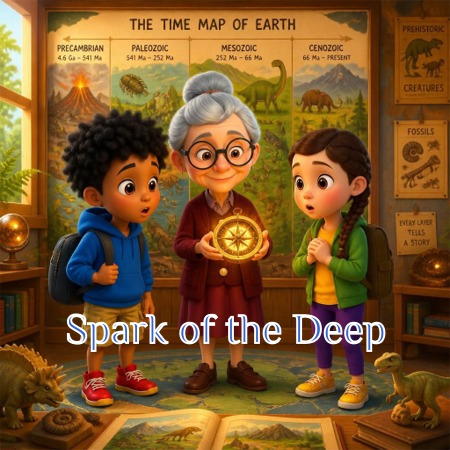
Spark of the Deep
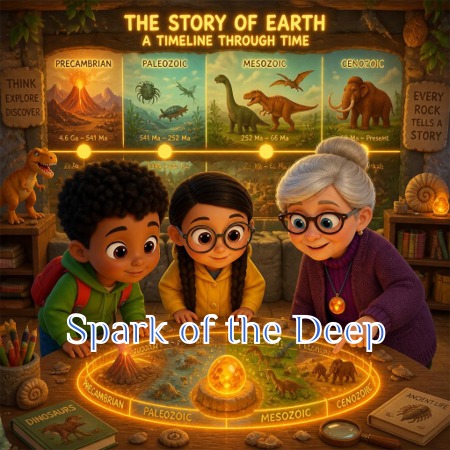
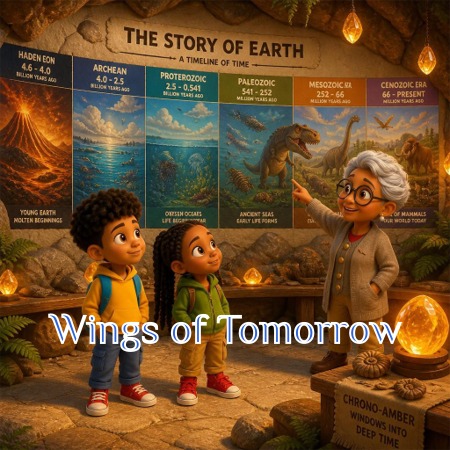
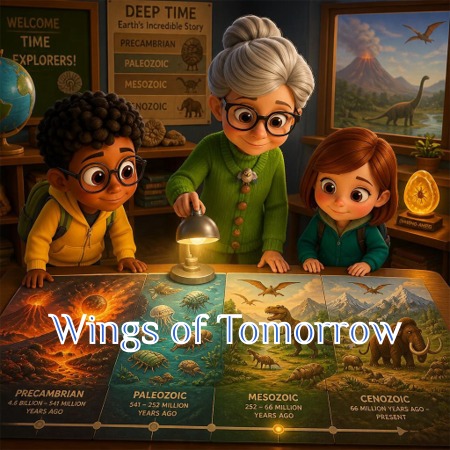
Kai usually liked maps more than tests, and Zoe liked puzzles more than worksheets. But when Mrs. Twitch drew a giant timeline across the classroom board, even the clock seemed to lean closer. She marked “4.6 billion years ago” and explained that Earth began as hot dust and rock circling the young Sun, crashing together until gravity built a whole planet.
After class, Kai and Zoe stayed behind, staring at the timeline as if it were a treasure trail. Mrs. Twitch opened a wooden drawer and said, “I have no sense of humor, but I do have the Core.” In her palm sat the Chrono-Amber Core, a glowing ancient amber fossil compass with tiny golden flecks swirling inside.
Mrs. Twitch explained that the Core worked only when both children touched it and shared the same goal. “It will protect your breathing with a faint shimmer,” she said, “but it will not stop falling rocks, boiling water, or foolish choices.” Kai and Zoe placed their fingers on the amber and whispered together that they wanted to see young Earth.
Warm amber light liquefied, flowed like honey over their hands, and pulled them through swirling golden dust. The classroom vanished, and a red-black world roared below them. Volcanoes spat lava, ash stormed through the sky, and lightning flashed over a surface so hot that Kai’s sneakers curled at the edges of their protective shimmer.
Zoe opened her time-map notebook, though her pencil shook a little. “So Earth was not born with forests and oceans,” she said. Kai nodded as glowing lava cooled into dark crust, the planet’s thin rocky skin. Mrs. Twitch’s lesson echoed in his mind: heavy materials like iron sank inward to form the core, while lighter rock floated above.
The ground trembled as space rocks streaked overhead, leaving fiery trails. Early Earth was still being shaped by impacts, volcanoes, and heat left from its formation. The faint golden shimmer around Kai and Zoe let them survive the choking gases, but it did not make the place cozy, so they hopped carefully from one solid patch of crust to another.
Clouds thickened as volcanoes released water vapor, carbon dioxide, nitrogen, and other gases. For a long time, steam filled the air, but as Earth cooled, rain began to fall for thousands and thousands of years. The drops hissed on hot rock, gathered in low places, and slowly helped make the first oceans.
The Core tugged gently toward the dark water, and Zoe checked the shimmer before they followed. Down they sank, past dim waves, until black towers rose from the seafloor like chimneys. These were hydrothermal vents, cracks where hot, mineral-rich water poured from inside Earth and mixed with cold seawater.
Kai watched cloudy plumes swirl around the vents. “No sunlight down here,” he said, “so how could anything live?” Zoe remembered the word chemosynthesis, using chemical energy instead of sunlight. Scientists think places like these may have helped early microbes survive, because vents offered warmth, minerals, and energy-rich chemicals.
Near a rock, Zoe spotted tiny bubble-like films clinging in a slippery layer. Mrs. Twitch had warned them that the first life would be microscopic, too small to see as animals or plants. Microbes are living things made of one cell, and early microbes probably left clues in chemical patterns and ancient rocks rather than footprints.
The Core carried them forward in time, not with a huge jump, but like skipping stones across ages. The seas grew calmer and sunlight reached shallow water. Some microbes learned photosynthesis, a process that uses sunlight, water, and carbon dioxide to make food, and releases oxygen as waste, though “waste” can change a world.
In warm shallows, Kai and Zoe saw mound-like mats called stromatolites. These layered structures were built by communities of microbes, including cyanobacteria, a name meaning blue-green bacteria. Bubble after bubble of oxygen rose, but at first the oxygen did not stay in the air because it reacted with dissolved iron, making rusty minerals that settled on the seafloor.
A new time-map line glowed: about 2.4 billion years ago, the Great Oxygenation Event. Oxygen finally built up in the atmosphere, turning Earth’s sky chemistry into something more like the air animals would need much later. It was helpful for future life, but dangerous for many older microbes, proving that a planet-changing success can also force living things to adapt.
Kai looked at the map, amazed that tiny cells had transformed oceans, rocks, and air. The Core pulsed softly, then dimmed, because it had to rest between major jumps by absorbing ambient life signatures from the world around it. “Next,” Zoe whispered, “let’s see what life becomes after Earth learns to breathe,” and Kai grinned as golden dust began to curl homeward.