 EN326–8
Story preview
Runway to the Clouds
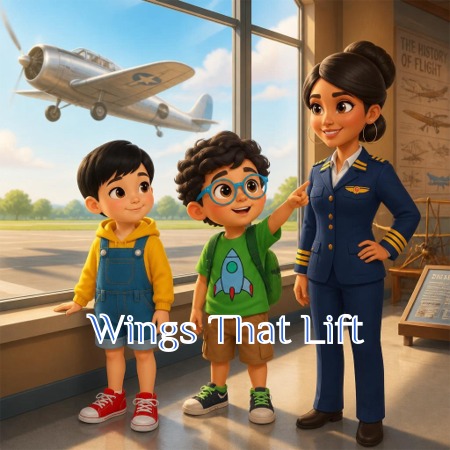
Kai pressed his nose near the wide airport window as a small blue airplane rolled past. Its spinning propeller blurred like a silver fan, and its landing gear, the wheels and struts underneath, bounced gently on the pavement. Zoe folded her arms. “That machine looks like a bus with wings. Explain how it does not simply fall over dramatically.” Kai grinned, ready to investigate every bolt and blinking light nearby.
They followed signs to a viewing area beside the runway, the long, flat road airplanes use for takeoff and landing. Painted lines showed pilots where to steer, while red signs marked places visitors must never enter. “Safety first,” Kai said, pointing at a fence. “We listen to airport workers, stay behind barriers, and keep bags close, because engines can pull air very strongly.” Zoe stepped back one extra step, just in case.
Inside the terminal, Zoe studied a model jet hanging from the ceiling. “Heavy metal, fuel, luggage, snacks, and people,” she counted. “I still vote for staying on the ground.” Kai tore a scrap from his notebook and folded a paper airplane. When he threw it, air moved faster over the curved top than underneath, making lift, an upward force that helps wings hold an airplane in the sky.
A real airplane began its takeoff roll, engines roaring with thrust. Thrust means a push forward; jet engines push hot fast air backward, and propellers push air backward like powerful spinning paddles. As speed built, air rushed around the wings. “The wings shape the air and push some downward,” Kai said, “so the airplane gets lift upward.” Zoe watched the nose rise. “Fine, giant bus. I see your trick.”
Through another window, they saw the cockpit, the front room packed with screens, levers, and radios. Pilots sit there to plan the route, check weather, and talk with the control tower, the tall building that organizes traffic in the sky and on the ground. Zoe pointed at the tail and wing flaps. Kai explained that small moving parts called control surfaces tilt the airplane, helping it turn left, right, up, or down safely.
Later, a training video showed the cabin, where passengers sit in rows. Flight attendants greeted everyone, checked seat belts, and explained exits; their job is comfort and safety, not just handing out juice. On landing, the airplane lowered its landing gear again. Flaps on the wings spread wide, helping it slow down, and the wheels touched the runway with a chirp. “Seat belts stay fastened until the crew says so,” Zoe recited, sounding official.
At sunset, Kai and Zoe watched baggage carts, mail crates, and a small rescue helicopter near the hangars. Airplanes carried families to far cities, medicine to sick people, food to islands, and letters across oceans. Zoe smiled sideways. “All right, I admit flying is useful, even if the snacks are tiny.” Kai laughed. “Different vehicles have different jobs, but they all connect people. Today, the sky became a road.”