 EN9–12
Story preview
Countdown to Space
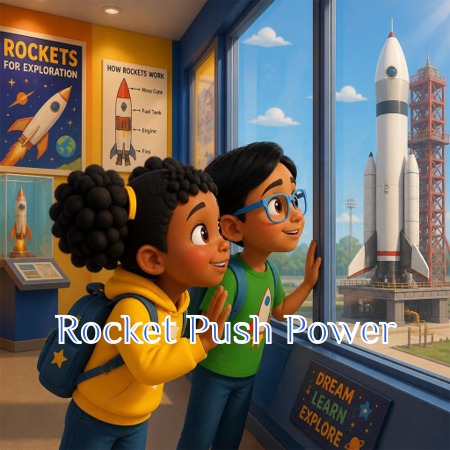
Kai pressed his nose to the visitor-center window as the white rocket towered above the Florida launch pad. Beside him, his field notebook filled with rocket doodles. Zoe folded her arms, squinting at the giant machine. “So, is that the spaceship, or just the world’s loudest elevator?” Kai grinned. A sign showed labeled parts: booster, upper stage, capsule, and escape tower. “Both sort of,” he said, “but the rocket launch vehicle is the powerful ride that pushes the spacecraft off Earth.”
Outside, heat shimmered over the launch pad’s concrete flame trench, where roaring exhaust would be guided safely away. The ocean wind smelled salty and warm. Kai pointed to the stacked stages. “Each stage has engines and fuel, then drops off when empty, making the rest lighter.” Zoe eyed the safety fences, lightning towers, and distant viewing area. “So nobody stands nearby yelling, ‘Good luck!’?” Kai shook his head. “Nope. Launch vehicles use explosive chemical energy, so people watch from far away.”
Inside the exhibit capsule, Kai squeezed into a seat tilted on its back. Velcro strips covered the gray panels. “This is the spacecraft,” he said, tapping the wall, “the part built to carry people, computers, air, water, and experiments after the rocket lets go.” Zoe found the tiny food packets and a strange toilet diagram. “Important science question: how do you pee when everything floats?” Kai laughed. “Airflow pulls waste into the right place. In microgravity, even crumbs need rules.”
At a training station, they clipped toy tools to a spacesuit glove. Kai imagined stepping outside a spacecraft, tethered like a kite, with Earth glowing blue below. “A spacesuit is a tiny personal spacecraft,” he said. “It gives oxygen, pressure, cooling, and radio contact.” Zoe bounced in a harness that made her feel lighter. Their name badges swung on springy cords. “Sleeping must be weird,” she said. Kai nodded. “Astronauts zip into wall sleeping bags so they don’t drift into buttons.”
The next room looked like Mission Control, with rows of screens showing maps, timers, and a satellite orbit. Tiny lights blinked like busy fireflies. Kai read that a satellite is a spacecraft that circles a planet or moon, using cameras, antennas, or instruments. Zoe pointed at storm pictures swirling over oceans. “So spaceships are not just for heroic waving?” “Right,” Kai said. “They forecast weather, send phone and internet signals, guide maps with GPS, and study Mars, the Moon, and Earth’s forests.”
On a big screen, an animation showed liftoff. The floor speakers rumbled under their shoes. Engines burned fuel with oxygen, pushing hot gas downward; the rocket rose upward because forces act in opposite pairs. Kai whispered, “Gravity pulls everything toward Earth, so the rocket must go incredibly fast to reach orbit.” Zoe watched the capsule separate and unfold shiny solar panels. “Free electricity?” she asked. “Sunlight electricity,” Kai said. “Solar panels power radios, computers, heaters, and batteries when the spacecraft crosses Earth’s shadow.”
Finally, the screen showed re-entry, when a returning spacecraft dives into air and its heat shield glows from friction and compressed air. Parachutes opened, and the capsule splashed safely into the sea. A clock counted down for tomorrow’s test. Kai breathed out. “Brave, but planned.” Zoe smiled sideways. “So the rocket is the throw, the spacecraft is the traveler, and safety is the boss.” Kai gave a salute. Outside, the real rocket waited, connecting Earth to space one careful mission at a time.