 EN49–12
Story preview
Walking the Rift
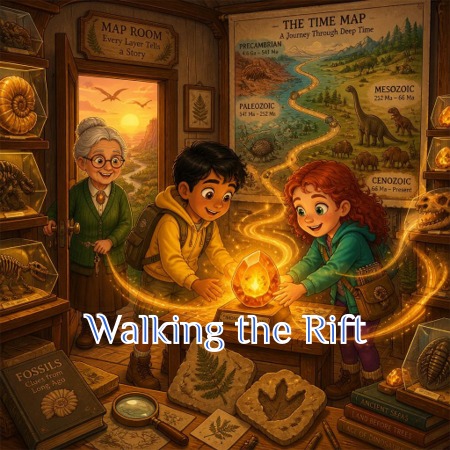
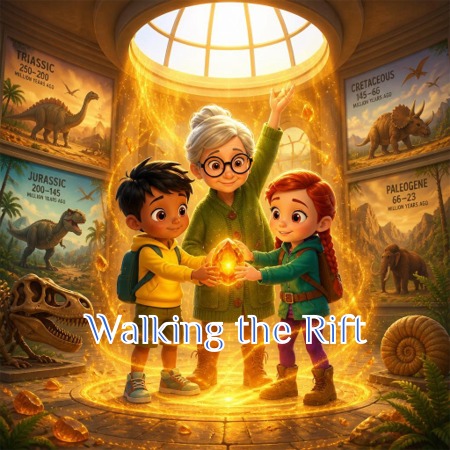
Mrs. Twitch placed the Chrono-Amber Core on the classroom time-map, where its trapped fossil insect glowed like sunrise. “It has rested long enough,” she said, explaining that the Core recharged by absorbing ambient life signatures, tiny traces left by living things. Kai leaned closer. “Our goal is land life,” he said, and Zoe nodded. “Show us when Earth finally got crowded on shore.”
Both children touched the amber compass at the same time. Warm amber light liquefied, flowed like honey over their hands, and pulled them through swirling golden dust. A faint protective shimmer wrapped around them, and Mrs. Twitch’s voice followed: “It helps with air, heat, and cold, but it cannot stop teeth, claws, falling trees, or your own bad decisions!”
They landed in a Carboniferous coal swamp about 310 million years ago, where the air smelled wet, green, and muddy. Towering club mosses, giant horsetails, and seed ferns rose like strange forests, although none were true flowering plants. Zoe checked the time-map. “When these plants died, mud buried them, and over millions of years pressure changed them into coal.”
A dragonfly-like insect with wings wider than Kai’s arm buzzed past his nose. “Why so huge?” Kai whispered. Zoe read the glowing label: oxygen levels were higher than today, helping some insects grow large. The Core shimmer let them breathe comfortably, but it did not stop Kai from slipping in black mud, so Zoe hauled him up before a rotten trunk splashed down.
Near a pool, a broad-headed amphibian crawled from the water, its skin shining like wet clay. Mrs. Twitch’s recorded note explained that amphibians still needed damp places because their eggs could dry out. Farther on, a small reptile scurried under roots; reptiles had tougher, shelled eggs that could survive on land, a key adaptation, or useful body feature, for drier places.
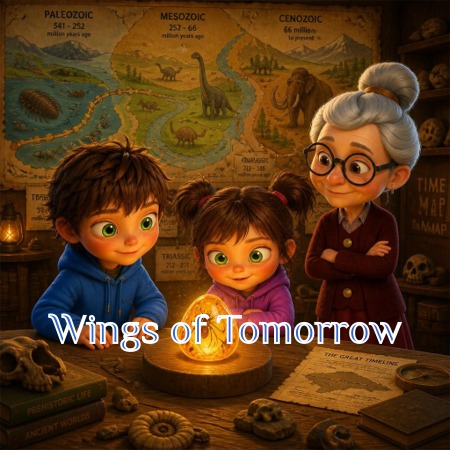
The time-map unfolded above them like a glowing puzzle. “All the continents are joining into one supercontinent,” Zoe said. “Pangea means all Earth.” Kai watched coastlines click together on the map. Mrs. Twitch’s note described continental drift: Earth’s crust is broken into slow-moving plates, and heat inside the planet helps push them around, carrying continents like rafts.
Golden dust spun again, and the swamp dried into a Permian plain under a harsh sun. A sail-backed animal stalked between scrubby plants, its tall spine-sail catching the light. “Dimetrodon!” Kai said, then corrected himself from the label. “Not a dinosaur. A synapsid, from the big family line that later led to mammals.” When it lunged at another animal, the children hid fast.
The ground trembled, and Zoe gripped Kai’s sleeve. “The shimmer won’t protect us from being trampled,” she reminded him, pulling him behind a boulder. The time-map showed climate shifts as Pangea’s huge inland areas became dry deserts, far from ocean rain. Later in the Permian, terrible volcanic eruptions and warming would help cause Earth’s largest mass extinction, when most species disappeared.
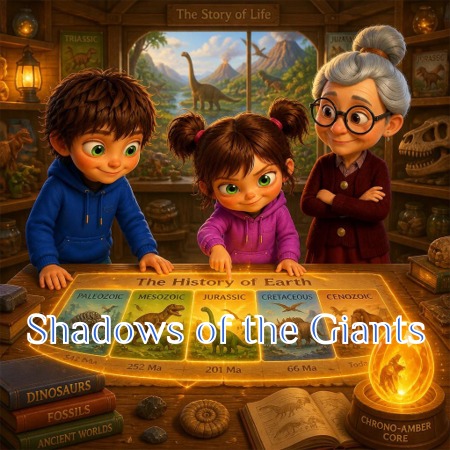
Back in Mrs. Twitch’s classroom, golden dust settled across the time-map like glittering sand. The children traced the journey: swamps to deserts, Pangea forming and cracking, synapsids rising, extinctions clearing space, and tiny dinosaurs taking their first steps. Mrs. Twitch smiled. “Next?” Kai and Zoe touched the resting Core together. “We follow dinosaur evolution into the age of giants.”