 EN129–12
תצוגה מקדימה של הסיפור
Wings of Tomorrow
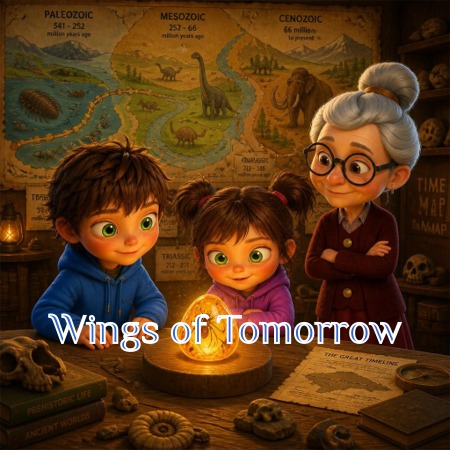
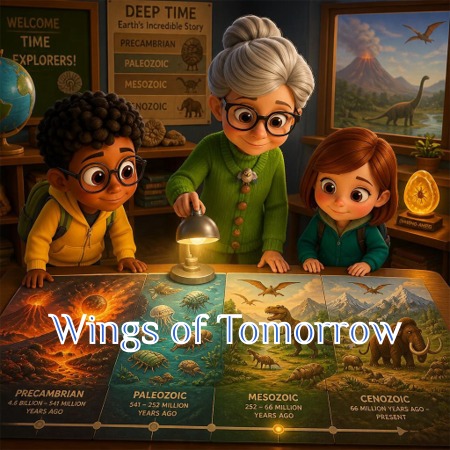
Kai and Zoe stood beside Mrs. Twitch’s classroom timeline, which now stretched across three walls and one cupboard door. Their first four Chrono-Amber journeys had shown fiery young Earth, ancient seas, reptile kingdoms, and the terrible asteroid flash. One space remained blank: what happened after extinction?
Mrs. Twitch placed the Chrono-Amber Core on the desk between them. “Same rule,” she reminded them. Kai and Zoe touched the glowing fossil compass and said together, “We want to see how life recovered.” Warm amber light liquefied, flowed like honey over their hands, and pulled them through swirling golden dust.
They landed in gray silence, about 66 million years ago, just after the asteroid impact. The air was thick with ash, and the Sun looked like a weak coin behind dusty clouds. A faint protective shimmer wrapped around them so they could breathe, but when a burnt branch cracked overhead, they still had to jump away fast.
“This is the K-Pg extinction,” whispered Zoe, remembering the boundary layer scientists find in rocks. Many non-avian dinosaurs, pterosaurs, and sea reptiles had died because sunlight was blocked, plants failed, and food chains collapsed. Yet under a log, Kai spotted Midge, a tiny mammal survivor, nibbling seeds in the dimness.
The Chrono-Amber Core pulsed softly but did not jump. It had to rest between major trips by absorbing ambient life signatures, the tiny energy patterns of living things. Ferns pushed through black soil, insects crawled from bark, and Ash-Wing, a small bird, fluttered to a branch. The time-map brightened with each survivor.
Years rushed past like golden rain. Plants returned first, making food by photosynthesis, which means using sunlight to build sugars. Insects followed the flowers and leaves. Small mammals explored places called niches, the jobs organisms have in an ecosystem: seed eater, climber, digger, hunter, swimmer, or night-time sniffer.
The Core carried them into the Paleocene, when mammals were still mostly small but wonderfully busy. With many giant reptiles gone, empty niches opened. This burst of new forms is called adaptive radiation: one group spreads into many habitats and evolves different bodies. Kai laughed when a tree-climbing mammal dropped fruit on his shoe.
At last, golden dust swirled them back into Mrs. Twitch’s classroom, where the bell was still five minutes away. Kai had ash on one sleeve, and Zoe had written “birbs = dinos” in her notebook, then crossed it out and corrected it: “birds are living avian dinosaurs.” Mrs. Twitch beamed at the improvement.