 EN79–12
תצוגה מקדימה של הסיפור
Spark of the Deep
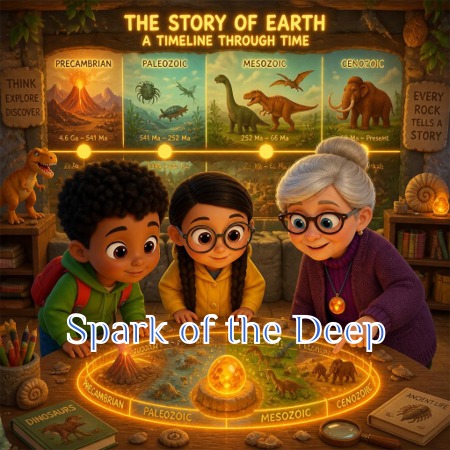
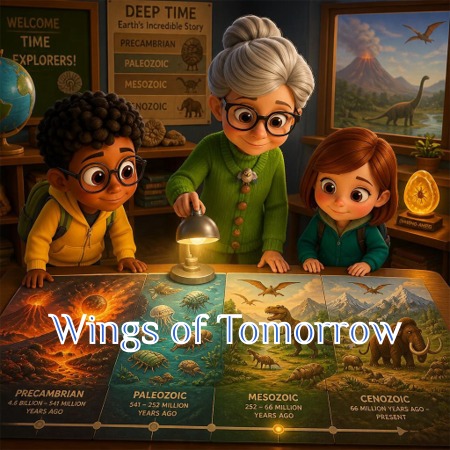
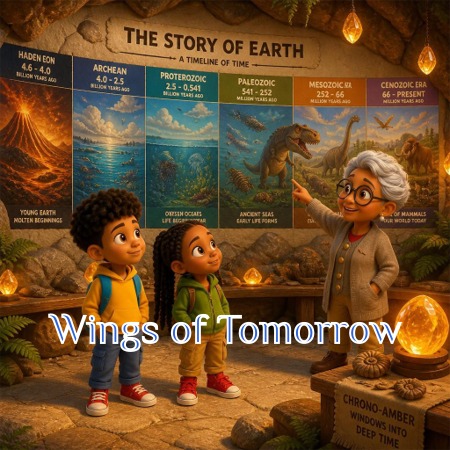
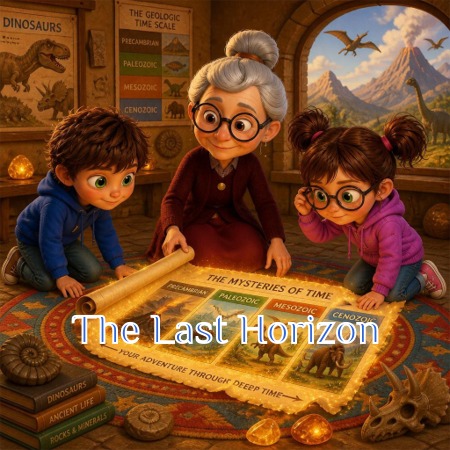
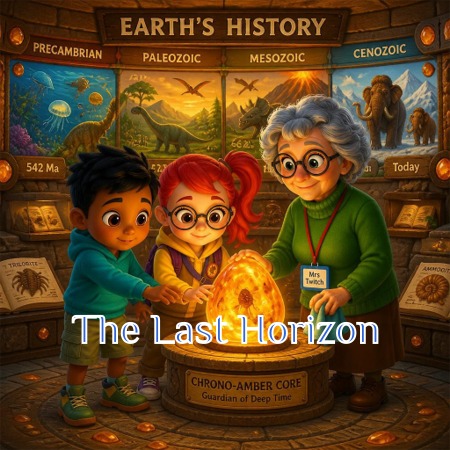
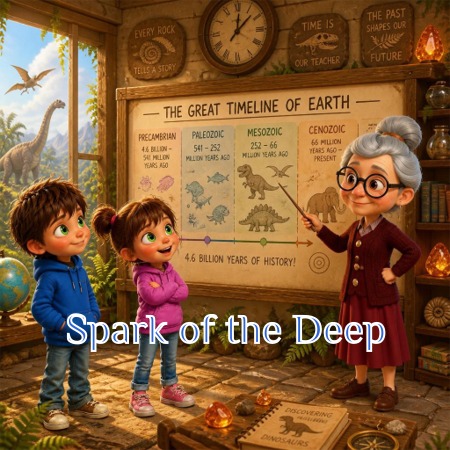
Kai and Zoe were not usually the strongest students in Mrs. Twitch’s class. But today she unrolled a five-book time-map series across the board, showing Earth changing from a fiery ball to a world of forests, dinosaurs, mammals, and birds. “I have no sense of humor,” Mrs. Twitch said, tapping the map with a ruler, “but I do have the Core.” From her desk drawer, she lifted a glowing ancient amber fossil compass. A tiny insect was trapped inside it, like a secret from deep time. “This Chrono-Amber Core activates only when both of you touch it and share the same goal,” she explained. “It helps you breathe in strange air with a protective shimmer, but it will not stop falling rocks, lava, or foolish decisions.” Kai leaned closer. “How did Earth even begin?” Mrs. Twitch’s eyes brightened, though her mouth stayed serious. She explained that about 4.6 billion years ago, dust and rock circled the young Sun. Gravity pulled pieces together, and crashes made a hot newborn planet. Heavy iron sank inward to form the core, while lighter rock floated above, eventually becoming crust.
After class, Zoe held the amber compass carefully. Kai touched it too, and they spoke together: “We want to see young Earth.” Warm amber light liquefied, flowing like honey over their hands. The classroom stretched into threads, golden dust swirled around their shoes, and the Chrono-Amber Core pulled them through time with a soft humming sound.
They landed on a blistering red world under a dark, hazy sky. Volcanoes spat glowing lava, lightning flashed through clouds of steam and ash, and meteor sparks scratched the heavens. A faint golden shimmer wrapped Kai and Zoe like soap-bubble armor, letting them breathe the ancient atmosphere. Still, when hot stones bounced nearby, they ducked behind a black basalt ridge fast. “The shield is not a helmet for bad ideas,” Zoe said, copying Mrs. Twitch’s tone. Kai laughed nervously and opened their time-map notebook. They labeled the scene: Hadean Earth, when the surface was extremely hot and constantly changing. The crust, Earth’s thin rocky skin, was still cooling and cracking. Lava hardened into dark rock, then broke again as the restless planet shifted.
Time blurred as the Core carried them forward in small hops. The golden dust cleared, and rain poured from huge clouds for ages. Steam condensed, which means it cooled from gas into liquid water. Comets and water-rich minerals may also have added water. Low places filled, and early oceans spread over the young crust, though the seas were hot, salty, and rough.
Kai and Zoe rode the shimmer down through the ocean. Sunlight faded, but ghostly towers appeared on the seafloor, smoking like chimneys. These were hydrothermal vents, cracks where seawater sank into hot rock, picked up minerals, and rushed back out. The water near them carried chemicals that could provide energy, making vents possible homes for life’s earliest experiments.
On a rocky surface near a vent, Zoe spotted tiny bubble-like shapes in slimy films. “Are those animals?” she whispered. “Too early,” Kai said, checking the Core’s time-map glow. They were microbes, living things so small they could be seen only with magnification. Early microbes had no eyes, bones, or mouths, but they could use chemicals, copy themselves, and survive in tough places. The Core projected a bright edu-cartoon enlargement above the vent. The microbes looked like tiny blobs with soft edges, not monsters at all. Mrs. Twitch’s recorded voice crackled from the compass: “Life is not always large. A microbe is a single-celled organism. One cell can do the jobs of being alive: taking in energy, growing, and making more cells.”
Another jump carried them to shallow seas dotted with lumpy layered rocks called stromatolites. Blue-green mats of cyanobacteria spread over the surfaces like living carpets. These microbes used photosynthesis, a process that catches sunlight to make food from water and carbon dioxide. A waste gas came out: oxygen. Kai grinned. “Their trash is our treasure!” At first, oxygen did not fill the air. It reacted with iron dissolved in the oceans, making rusty minerals that settled in stripes on the seafloor. The time-map showed banded iron formations, rocks with red layers that still exist today. Slowly, after many millions of years, the iron traps filled up. Extra oxygen began building in the atmosphere during the Great Oxygenation Event.
The change was wonderful but also difficult. Oxygen helped future animals by making energy use more powerful, but it was poisonous to many older microbes that lived without it. Some survived in mud, deep water, or other places with little oxygen. Zoe looked at the tiny cyanobacteria and said, “They did not mean to change the planet, but they did.” Kai added, “Small life, huge effect.” The Chrono-Amber Core grew dim and heavy. It needed to rest between major jumps by absorbing ambient life signatures from the living world around it. Back in the classroom, golden dust slid from their sleeves like glittering sand. Mrs. Twitch raised one eyebrow. Kai and Zoe pointed to the next blank route on the five-book time-map. “When the Core is ready,” Zoe said, “we want to see what life becomes next.”