 EN149–12
Leseprobe
The Science of Shadows
Maya was playing in the park on a sunny afternoon when she noticed something following her everywhere she went. No matter how fast she ran or which direction she turned, a dark shape moved along the ground beneath her. "My shadow!" she laughed, jumping and watching it jump too.
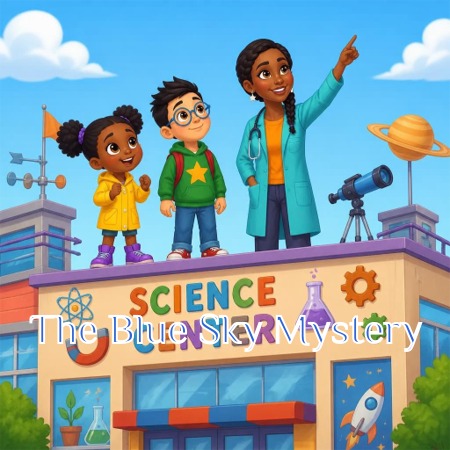
But then Maya stopped and wondered: why do we have shadows at all? She decided to visit her neighbor, Dr. Chen, a scientist who always had interesting answers to her questions. Dr. Chen smiled when Maya asked about shadows and invited her into the backyard for some experiments.
"Shadows are created when something blocks light," Dr. Chen explained, holding up a ball between Maya and the sun. "Light travels in straight lines, and when an object gets in the way, it can't pass through. The dark area behind the object is the shadow." Maya watched as the ball's shadow appeared on the ground, perfectly round and dark.
Dr. Chen brought out a flashlight to show Maya how shadows work even without the sun. She placed different objects in front of the light: a book, a toy dinosaur, and even her hand. Each object created a shadow on the wall behind it. "See how the light rays can't bend around the objects?" Dr. Chen asked. "They hit the object and stop, leaving darkness on the other side."
Maya noticed that her shadow changed size throughout their experiment. When Dr. Chen held the flashlight close to an object, the shadow grew huge and stretched across the wall. When she moved the light farther away, the shadow became smaller. "The position of the light source changes the shadow's size and shape," Dr. Chen explained.
Dr. Chen told Maya about a brilliant mathematician from ancient Greece named Eratosthenes who lived over 2,000 years ago. Eratosthenes used shadows to do something amazing: he calculated the size of the entire Earth! He noticed that at noon on a certain day, the sun shone straight down a well in the city of Syene, creating no shadow at all.
"That's incredible!" Maya exclaimed. "A shadow helped someone measure the whole planet?" Dr. Chen nodded enthusiastically. "Shadows have been useful tools for thousands of years. Sundials use shadows to tell time, and astronomers study the shadows during eclipses to learn about the moon and sun."
As the sun began to set, Maya noticed her shadow growing longer and longer, stretching across the entire yard. "Why is it so long now?" she asked. Dr. Chen explained that when the sun is low in the sky, light hits objects at a very shallow angle, creating extremely long shadows.