 EN1610–12
Leseprobe
The Race to the Moon
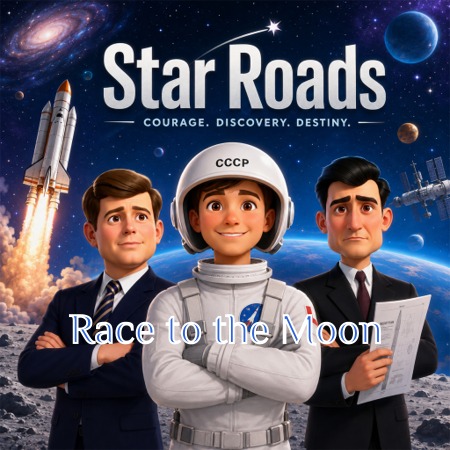
In the 1960s, the world watched as two powerful countries competed in an exciting challenge called the Space Race. The United States and the Soviet Union each wanted to be the first to achieve amazing feats in space, and the greatest prize of all was reaching the Moon.
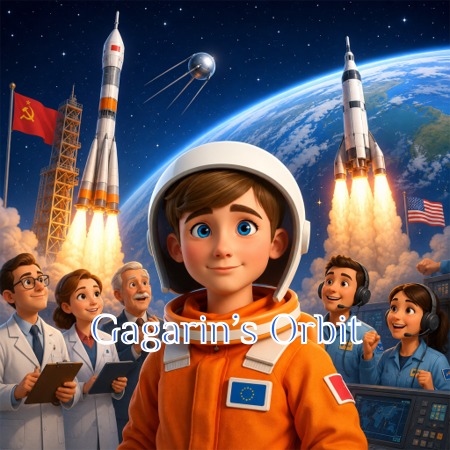
The Soviet Union took an early lead when cosmonaut Yuri Gagarin became the first human in space on April 12, 1961. His spacecraft, Vostok 1, orbited Earth for 108 minutes, proving that humans could survive in space. This achievement shocked and inspired people around the world.
President John F. Kennedy knew America needed to catch up in this competition. On May 25, 1961, he made a bold promise to the American people: the United States would land a man on the Moon and return him safely to Earth before the end of the decade. It was an enormous challenge that would require brilliant scientists, brave astronauts, and incredible technology.
NASA, America's space agency, began working on the Apollo program to make Kennedy's dream come true. Engineers and scientists developed powerful rockets called Saturn V, which stood as tall as a 36-story building. These rockets needed to be incredibly strong to escape Earth's gravity and travel the 240,000 miles to the Moon.
Meanwhile, both countries continued their space programs with determination. The Soviets achieved several important milestones, including the first spacewalk and the first unmanned spacecraft to land on the Moon. The Americans practiced docking spacecraft together in orbit and tested their equipment on missions that circled the Moon.
The Apollo program faced tragedy in 1967 when three astronauts died in a fire during a test on the launch pad. This terrible accident reminded everyone how dangerous space exploration was. NASA made hundreds of safety improvements to protect future astronauts.
Finally, on July 16, 1969, Apollo 11 launched from Kennedy Space Center in Florida. Astronauts Neil Armstrong, Buzz Aldrin, and Michael Collins began their historic journey aboard a Saturn V rocket that roared into the sky with flames brighter than the sun. Millions of people watched on television as the rocket climbed higher and higher.
As Armstrong's boot touched the Moon's dusty surface, he spoke words that would be remembered forever: 'That's one small step for man, one giant leap for mankind.' Buzz Aldrin joined him soon after, and together they spent over two hours exploring, collecting rock samples, and setting up scientific instruments.